

Origins of the first rugs
The knotted rug is one of humanity's oldest art forms. Its roots reach back more than two and a half millennia — from the nomads of Central Asia to the workshops of the Persian court.
#The Pazyryk rug — the oldest surviving knotted rug
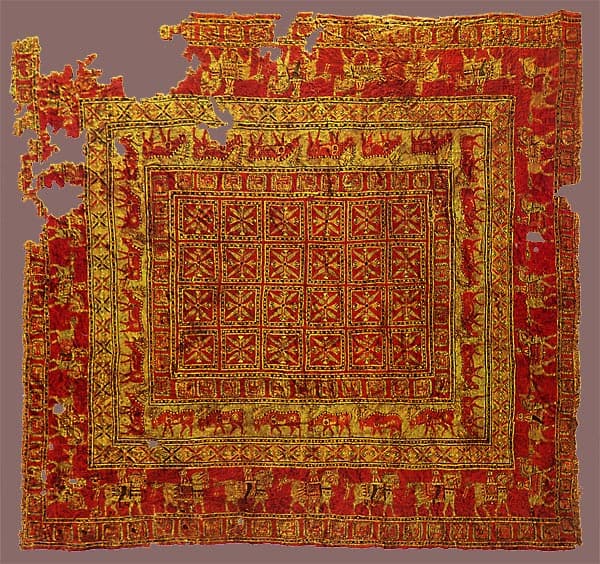
Photo: Wikimedia Commons · Public Domain
The oldest fully preserved hand-knotted rug comes from a Scythian princely tomb in the Altai Mountains and dates to the 5th century BC. Russian archaeologists discovered it in 1949 under a layer of ice that had preserved it for over two and a half millennia. The so-called Pazyryk rug measures 1.83 × 2.00 meters, shows a surprisingly fine knot density of around 360,000 knots per square meter, and bears a strictly composed pattern of riders, deer, and geometric borders. Its craftsmanship proves that the art of knotting had been refined over many generations before its creation — it is therefore not the beginning, but an early high point of a long-established tradition.
#Nomadic roots in Central Asia
The actual origins of the knotted rug lie with the nomadic pastoral peoples of Central Asia, probably in the area of present-day Kazakhstan, Kyrgyzstan, and northern Iran. Sheep and goats provided the wool, processed on the portable loom into tent cloths, saddle covers, and floor coverings. From the first flat weaves — the kilims — pile knotting developed: by pulling short woolen threads into the base fabric, a warm, elastic surface was created that withstood the hard floors of yurts. Every tribal community developed its own patterns, knots, and color traditions, passed down orally and by hand over centuries.
#From nomadic tent to city workshop
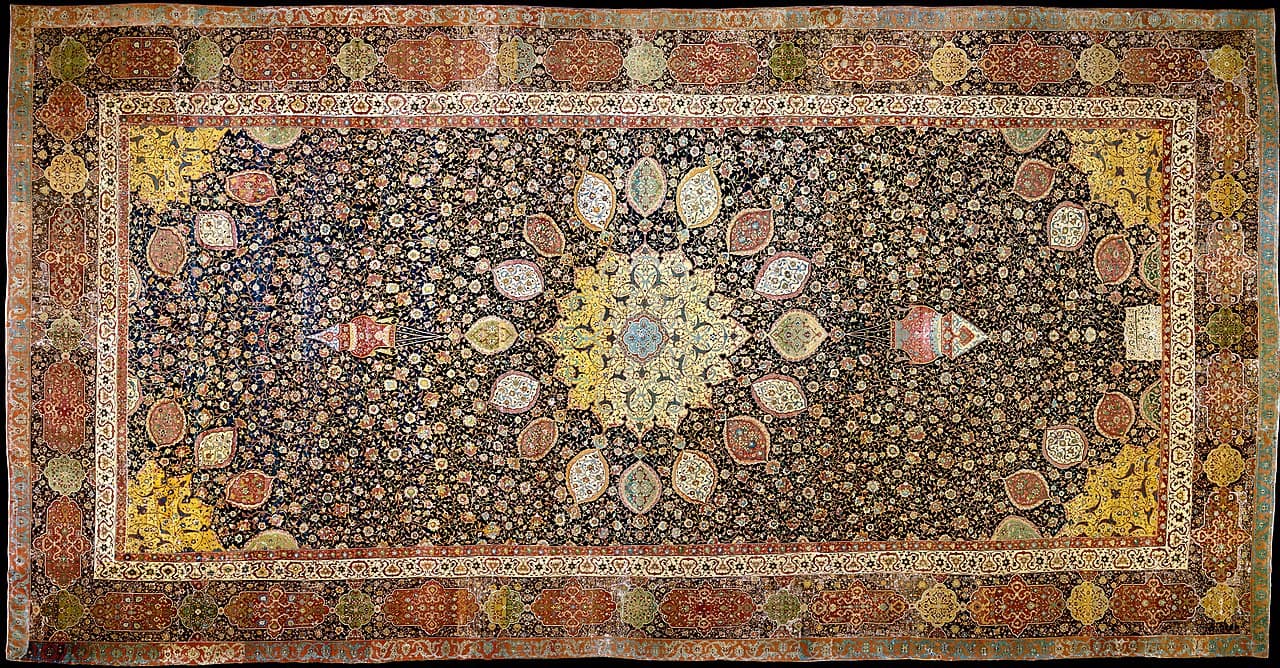
Photo: Wikimedia Commons / Google Art Project · Public Domain
With settlement and the rise of urban centers, the art of knotting moved from tent to workshop. From the late Middle Ages onwards, cities like Tabriz, Kashan, Isfahan, and Herat became centers of manufactory knotting. Here the first large-format rugs were created for courtly clients — complex medallion rugs, garden rugs, and hunting scenes that were no longer knotted from memory but according to millimeter-precise cartoons. The Safavid dynasty (1501–1722) systematically promoted the art of rug-making in Iran: the so-called Ardabil rugs from this era are today among the most valuable testimonies of art history in museums such as the Victoria & Albert Museum in London.
#The Silk Road and global trade
As early as the early Middle Ages, oriental rugs were a sought-after commodity along the Silk Road. Caravans transported them from Persia and Central Asia to China, India, and Arabia; from there they reached Venice via the Ottoman Empire and on to Europe. Renaissance paintings — by Hans Holbein, Lorenzo Lotto, or Hans Memling — depict oriental rugs as status symbols on princely tables and altars. These works are important dating aids today because they allow us to trace which patterns came to Europe from which region at which time.
#The 19th century — rediscovery and industrialization
After centuries of relative stagnation, rug-knotting experienced a second bloom in the 19th century: European and American collectors rediscovered oriental rugs, triggering enormous demand. Trading houses such as the Swiss firm Ziegler & Co. founded their own workshops in Sultanabad (today Arak), adapted colors and patterns to Western taste, and delivered directly to Europe and the US. At the same time, hundreds of new workshops were founded in Iran, Turkey, and India. This era still shapes what we consider "classic" styles today — and it also marks the beginning of mechanical rug production in Europe.
#Today — tradition in transition
The knotting tradition continues to this day, albeit under changed conditions. Iran remains the leading producer of the finest manufactory rugs; Afghanistan, Pakistan, and India have established themselves as centers for Ziegler reproductions and modern designer rugs. Moroccan Berber rugs, Nepalese Tibetan rugs, and Turkish kilims also find global sales. At the same time, weavers face the challenge of adapting traditional techniques to changed working conditions, fair pay, and modern interior aesthetics — a tension that every hand-knotted rug carries within it.
Keep reading
How oriental rugs are made
How wool, silk, and natural dyes become a hand-knotted work of art — explained step by step.
ReadMaster weavers
The women and men behind the best-known rugs — historical and contemporary workshops.
ReadIdentifying oriental rugs
The key markers to distinguish a genuine hand-knotted oriental rug from imitations.
Read